
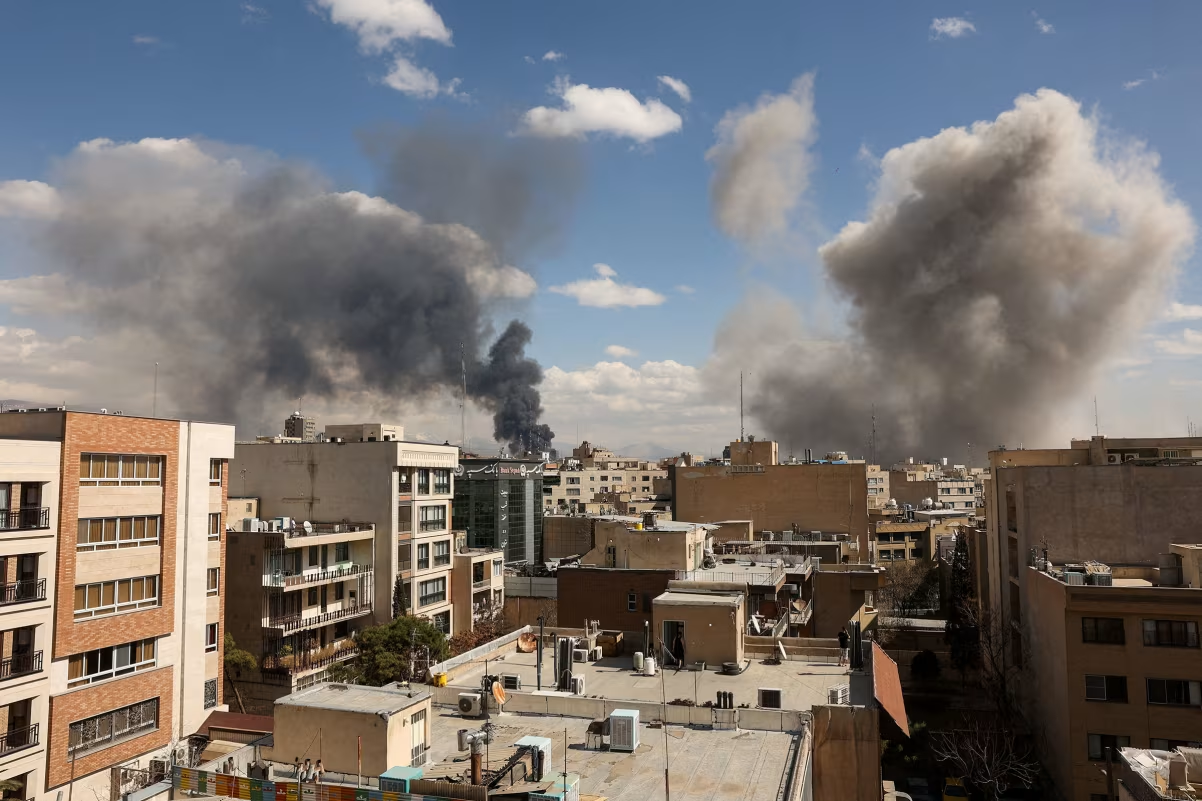
The escalation of military friction between the United States and Iran has triggered a wave of caution across global financial centers. Following recent strikes, a new CNN/SSRS poll reveals that 59% of Americans disapprove of the military action, while 56% of the public anticipates a protracted long-term conflict. As geopolitical risks shift from theoretical to operational, investors are recalibrating portfolios to account for heightened volatility in energy supplies and safe-haven assets.
Market Impact: Energy and Risk Appetite
The prospect of a “long-term military conflict,” as voiced by a majority of the US public, has immediate implications for global asset pricing. Historically, direct confrontations in the Middle East exert upward pressure on Brent and WTI crude benchmarks due to threats surrounding the Strait of Hormuz—a critical chokepoint for global oil transit.
- Commodities: Oil markets remain on high alert. Any disruption to supply chains or infrastructure in the region typically triggers a “risk-off” sentiment, leading to a spike in energy prices that could feed into global inflationary pressures.
- Equities and Bonds: Major global indices have shown sensitivity to the news, as uncertainty regarding a “clear plan” for the conflict—questioned by 60% of poll respondents—weighs on investor confidence. Concurrently, US Treasury yields often fluctuate as capital seeks the safety of government bonds during periods of geopolitical instability.
- Currency Markets: The US Dollar often acts as a primary haven. However, the internal political division noted in the poll—specifically the 62% of Americans demanding congressional approval for further action—introduces a layer of domestic policy uncertainty that currency traders are closely monitoring.
Context for Global Investors and Emerging Markets
For investors in Asia and emerging markets, the primary concern remains the “twin shocks” of energy inflation and capital outflow. As the US moves toward a potential sustained engagement, the following factors are critical:
- Monetary Policy Implications: If energy prices drive a resurgence in inflation, central banks, including the Federal Reserve, may be forced to maintain higher interest rates for longer. This scenario typically strengthens the USD, putting pressure on emerging market currencies and increasing debt-servicing costs for developing economies.
- Supply Chain Integrity: Beyond oil, regional instability can impact broader maritime trade routes. Global logistics firms are already factoring in higher insurance premiums and potential rerouting costs, which may impact the valuation of industrial and transport sectors.
- Investment Sentiment: The poll’s finding that only 28% of Americans believe these strikes will reduce the Iranian threat suggests that “geopolitical premium” will likely remain embedded in market prices for the foreseeable future.
Neutral Market Observation
Market participants are currently in a “wait-and-see” mode, balancing the potential for a short-term military engagement against the risks of a wider regional escalation. While the US administration suggests a timeline of roughly four weeks for operations, the skepticism reflected in public opinion polls suggests that the path toward de-escalation remains complex and non-linear.