
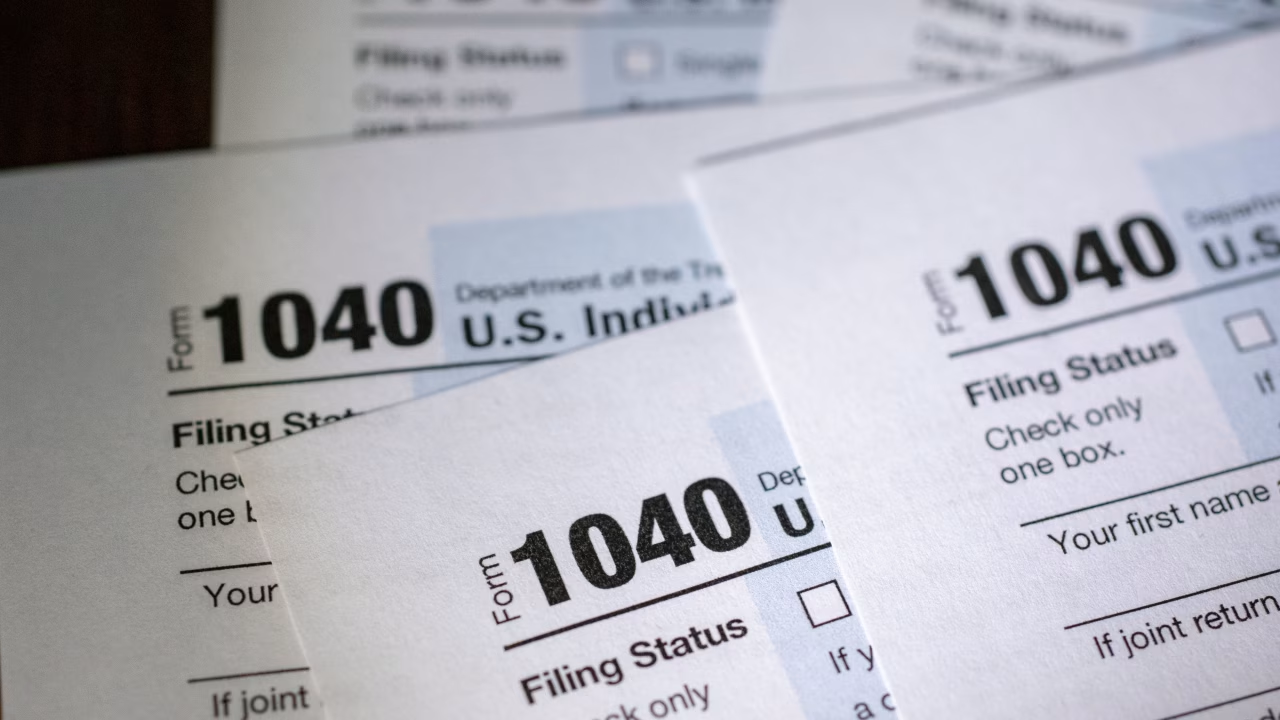
The calendar has a funny way of accelerating once April arrives and suddenly that distant mid-month deadline is staring you right in the face. With Tax Day 2026 falling on April 15, the countdown has officially entered the single digits. For most of us, this time of year is a high-wire act of balancing spreadsheets, hunting down stray receipts, and trying to remember if we actually received that one 1099-INT from a savings account we barely use. While the urge to just “get it over with” is incredibly strong, rushing through your tax return is often the quickest way to turn a potential refund into a long-term headache involving the IRS.
Every year, millions of Americans leave money on the table or inadvertently trigger audits simply because they overlooked a few basic details in the heat of the moment. The 2026 filing season is particularly unique because of recent legislative shifts and the evolving ways the IRS tracks digital income. If you are feeling the pressure of the looming deadline, take a deep breath. Avoiding a financial catastrophe doesn’t require a degree in accounting, but it does require a bit of strategic patience. Here is a deep dive into the most common pitfalls taxpayers face this week and how you can navigate them to ensure your filing is as painless as possible.
The High Cost of Choosing the Wrong Filing Status
It sounds like the simplest part of the entire process, but selecting your filing status is actually one of the most consequential decisions on your 1040. Your status dictates your standard deduction amount, your tax brackets, and your eligibility for a wide range of credits. Many people default to “Single” or “Married Filing Jointly” without considering how life changes in the previous year might have opened new doors. If you moved in with a partner, took on the primary financial support of an aging parent, or navigated a change in a custody arrangement, your “obvious” status might no longer be the most beneficial one.
The “Head of Household” status is perhaps the most misunderstood and frequently misapplied category. It offers a significantly higher standard deduction than filing as a single individual, which is why it is so attractive. However, the IRS is very strict about the requirements. You must have paid more than half the cost of keeping up a home for the year and had a qualifying dependent living with you for more than half the year. Miscalculating these percentages or claiming a dependent who doesn’t actually meet the legal criteria can lead to the IRS rejecting your return or, worse, demanding the tax benefit back with interest two years down the line. If your family situation felt complicated in 2025, it is worth using the interactive tax assistant on the IRS website to verify your status before you hit submit.
Navigating New Credits and the One Big Beautiful Bill Act
If you are using last year’s tax return as a literal template for this year, you are likely making a massive mistake. Tax laws are rarely static, and 2026 is no exception. With the full implementation of the One Big Beautiful Bill Act, several deductions and credits have been restructured. This piece of legislation changed the landscape for middle-class families and small business owners, meaning that what worked for you in 2025 might be obsolete now. Relying on muscle memory rather than reading the new fine print is a surefire way to leave a few hundred or even a few thousand dollars in the government’s pockets.
Beyond the major legislative shifts, many taxpayers simply forget to look for smaller, niche credits that add up. Whether it’s energy-efficient home improvements, student loan interest, or childcare expenses, these deductions act as a direct reduction of your tax bill rather than just a reduction of your taxable income. The nuance here is that some credits are refundable, meaning you get the money back even if you owe zero taxes, while others are non-refundable. Taking an extra hour to research how the 2026 changes apply to your specific income bracket is the highest-earning “hour of work” you will likely do all year.
The Extension Myth and the April 15 Payment Trap
One of the most dangerous misconceptions in American personal finance is the idea that filing a tax extension gives you more time to pay your taxes. This is a myth that costs taxpayers millions in late-payment penalties every single year. If you find yourself staring at the April 15 deadline and realize you simply don’t have the paperwork ready, you can absolutely file Form 4868 to get an automatic six-month extension to file your return. This pushes your filing deadline to October. However, that extension applies only to the paperwork, not the check you owe the IRS.
The IRS expects you to estimate your tax liability and pay that amount by April 15, 2026. If you file an extension but don’t send a payment, the interest and failure-to-pay penalties begin accruing the very next day. This can be a shock to the system for freelancers or small business owners who might be struggling with cash flow. Even if you cannot afford the full amount you think you owe, it is always better to pay as much as possible by the deadline. Partial payments significantly reduce the base amount upon which interest is calculated, saving you a substantial amount of money in the long run.
Simple Data Entry Errors That Freeze Your Refund
In an era of high-tech tax software, it seems almost impossible to make a “typo,” yet basic data entry errors remain one of the top reasons for delayed refunds. When you are rushing to beat the midnight deadline on the 15th, your fingers can easily betray you. A single transposed digit in a Social Security number or a misspelled name that doesn’t match Social Security Administration records can cause the IRS computer systems to flag your return for manual review. Once a return enters the manual review pile, your “21-day refund” window can easily turn into a three-month waiting game.
Banking information is another critical area where precision is non-negotiable. Direct deposit is the fastest way to get your money, but if you enter the wrong routing or account number, the consequences are messy. If the account number you provided doesn’t exist, the bank will eventually return the money to the IRS, and they will mail you a paper check, which adds weeks to the process. However, if you accidentally enter a valid account number that belongs to someone else, recovering those funds can be a nightmare. Always double-check your bank’s “Direct Deposit” tab in your mobile app rather than guessing based on a memory of your checkbook.
The Danger of Filing Before the Full Paperwork Trail Arrives
The early bird gets the worm, but the early taxpayer often gets an “Amended Return” bill. It is incredibly tempting to file in February or March as soon as your W-2 arrives, but in 2026, the gig economy and diverse investment portfolios make for a complicated paper trail. Many brokerage firms and digital payment platforms don’t issue their final 1099-B or 1099-K forms until late February or even March. If you file your taxes and then receive a corrected form in the mail a week later, you are legally required to file an amendment, which is a tedious and often confusing process.
If you are missing a form and the deadline is days away, don’t guess. One of the best tools at your disposal is the IRS.gov personal account portal. By creating an account and verifying your identity, you can view your “Tax Transcript.” This document shows exactly what has been reported to the IRS under your Social Security number by employers, banks, and contractors. If you see a 1099 on your transcript that you never received in the mail, you can use the information from the transcript to file accurately. It is a much safer bet than estimating income and hoping the IRS doesn’t notice the discrepancy.