
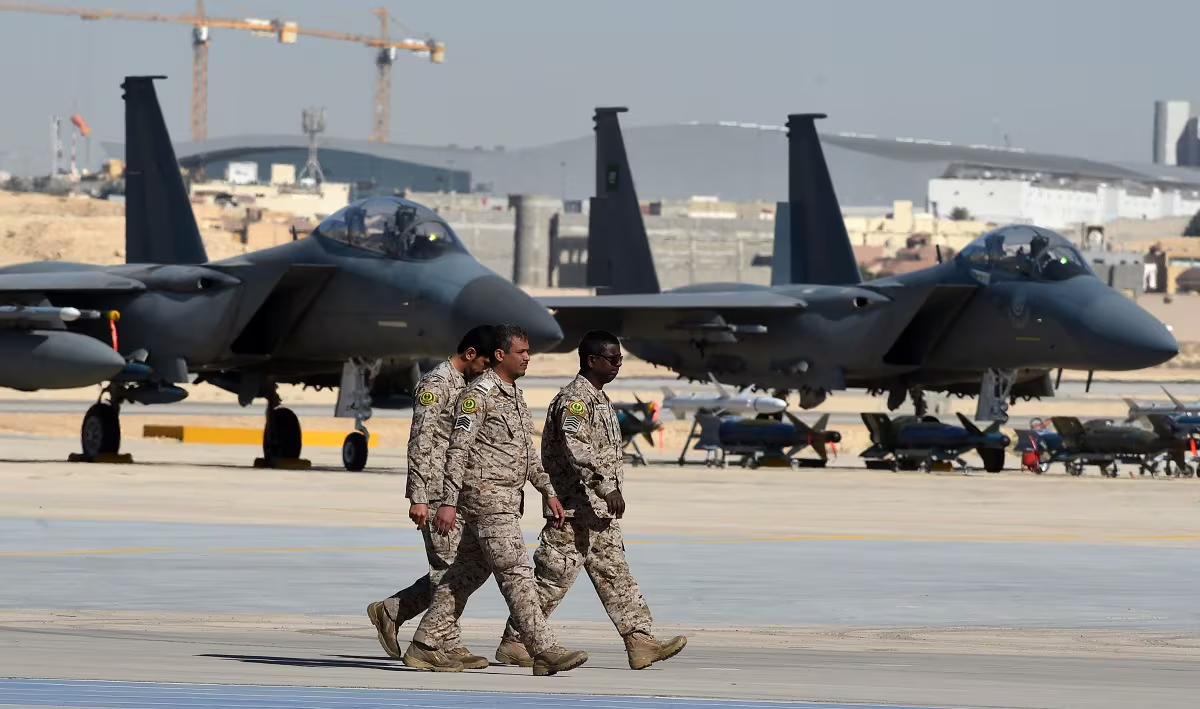
When conflicts escalate, the global focus usually shifts to the nations directly involved and the types of weapons deployed on the battlefield. However, a deeper look at the international defense market reveals a more complex reality: the countries paying for the weapons often hold as much power as those manufacturing them.
To truly grasp the geopolitical dynamics of modern warfare, it is essential to understand how Saudi Arabia influences global arms sales. As one of the world’s most significant financial backers, Riyadh’s foreign policy decisions can single-handedly greenlight or dismantle multibillion-dollar defense contracts. A recent example—the halted $1.5 billion arms deal between Pakistan and Sudan—provides a perfect case study of how financial diplomacy shapes the global flow of military power.
The Economics of Modern Warfare: Follow the Financing
The international arms trade is rarely a simple, direct transaction between a buyer and a seller. While emerging defense manufacturers are eager to export their domestic technology, the purchasing nations located in active conflict zones often lack the liquid capital to buy advanced hardware outright. This creates a heavy reliance on wealthy third-party benefactors.
Historically, major economic powers have used defense financing as a tool to expand their geopolitical influence. By acting as the financial guarantor for international arms deals, affluent nations can dictate which factions receive state-of-the-art jets, munitions, and logistical support. This dynamic effectively turns financial backing into a remote-control mechanism for foreign policy.
Why Supplier Capacity Isn’t Enough Anymore
Countries with rapidly growing defense industries, such as Pakistan, have successfully developed cost-effective, high-performing military assets like the JF-17 Thunder fighter jets. Following successful demonstrations of their capabilities, these weapons systems have attracted the attention of various international buyers. However, manufacturing capacity alone does not guarantee a successful sale. Without the backing of economic heavyweights to underwrite these massive transactions, defense contracts can stall indefinitely.
Case Study: Why the Pakistan-Sudan Deal Fell Through
The intersection of military manufacturing and third-party financing was recently put on full display in North Africa. Pakistan was in the final stages of a massive $1.5 billion agreement to supply fighter jets and advanced weaponry to Sudan. The deal was intended to bolster Sudan’s armed forces, which have been locked in a devastating, multi-year conflict with the paramilitary Rapid Support Forces (RSF).
Initially, Saudi Arabia brokered the negotiations. However, in a significant geopolitical pivot, Riyadh recently instructed Pakistan to terminate the agreement, officially withdrawing its offer to finance the purchase. Stripped of its financial foundation, the deal collapsed.
The Strategic Mutual Defence Agreement (SMDA) Effect
To understand why Pakistan immediately complied with the request to halt the lucrative sale, one must look at the broader diplomatic relationship between Islamabad and Riyadh. In late 2025, the two nations signed the Strategic Mutual Defence Agreement (SMDA), a sweeping security pact that treats aggression against one as an attack on both.
Saudi Arabia is not just a strategic ally to Pakistan; it is an economic lifeline, routinely providing critical loans to stabilize Islamabad’s economy. This deep-seated reliance means that when Riyadh signals a shift in its foreign policy objectives, its defense partners must align their export strategies accordingly.
Shifting Geopolitical Strategies in Africa
Saudi Arabia’s decision to withdraw financing from the Sudan deal is not an isolated incident. Instead, it reflects a broader recalibration of its foreign policy. The kingdom is actively re-evaluating its involvement in proxy wars across the African continent. Another $4 billion weapons deal intended for the Libyan National Army is reportedly facing similar jeopardy as Saudi authorities revisit their regional strategies.
Several key factors are driving this geopolitical shift:
- Western Diplomatic Pressure: Allied nations in the West have increasingly advised Riyadh to distance itself from prolonged proxy conflicts in Africa, prioritizing regional stability over military escalation.
- Competing Regional Interests: The proxy landscape is complicated by rivalries. In Sudan, Saudi Arabia has traditionally leaned toward the Sudanese army, while the United Arab Emirates (UAE) has faced accusations of providing logistical support to the opposing RSF. Stepping back financially helps de-escalate indirect tension between Gulf neighbors.
- Humanitarian Concerns: The conflict in Sudan has triggered one of the world’s most severe humanitarian crises. Financing billions in new weaponry risks drawing intense international backlash and further destabilizing a critical region near the Red Sea.
Market Impact: What This Means for the Global Defense Trade
When a major financial backer changes its strategy, the shockwaves are felt across the global defense market. For emerging arms exporters, this highlights a critical vulnerability: market expansion is inextricably linked to the geopolitical whims of their financiers.
If wealthy benefactors like Saudi Arabia continue to step away from funding foreign military purchases, the market dynamics will fundamentally shift. We may see a rise in smaller, piecemeal arms acquisitions rather than multibillion-dollar mega-deals. Furthermore, conflict zones may experience a “weapons drought” from traditional state suppliers, potentially opening the door for black-market arms dealers or less regulated actors to fill the void.
This paradigm shift also forces nations with growing defense sectors to seek out new financial models. Instead of relying on a single wealthy ally to underwrite a foreign sale, manufacturers might explore consortium financing or focus heavily on buyers who have the capacity to self-fund their defense budgets.
Conclusion: A New Era of Conditional Arms Financing
The global defense market is undergoing a subtle but profound transformation. As demonstrated by the recent halted deal in Sudan, understanding how Saudi Arabia influences global arms sales is crucial for geopolitical analysts, defense contractors, and market watchers alike. The era of unchecked proxy financing appears to be cooling, replaced by a more calculated, condition-based approach to international military support. As alliances deepen and foreign policy goals shift, the flow of global weaponry will continue to be dictated not just by who builds the weapons, but by who controls the purse strings.
Frequently Asked Questions (FAQs)
Why was the Pakistan-Sudan weapons deal canceled?
The $1.5 billion deal was put on hold because Saudi Arabia, which was originally brokering the agreement, decided to withdraw its financial backing. Without a third party to fund the purchase, Sudan lacked the capital to complete the transaction, and Pakistan paused the sale.
How does Saudi Arabia finance international arms purchases?
Wealthy nations often act as financial guarantors or direct financiers for arms deals involving less affluent nations. By funding these purchases, they can support allied factions in regional conflicts and exert geopolitical influence without deploying their own military forces.
What is the Strategic Mutual Defence Agreement (SMDA)?
Signed in 2025, the SMDA is a comprehensive security and defense pact between Pakistan and Saudi Arabia. It significantly strengthens their military and economic ties, meaning Pakistan closely aligns its defense export strategies with Saudi Arabia’s diplomatic and geopolitical goals.