
The geopolitical landscape has reached a fever pitch this week, and the entire world is essentially holding its breath. We are currently watching one of the most severe escalations in modern history as the United States and Iran stand on the brink of an unprecedented military conflict. At the center of this massive standoff is a strict, rapidly approaching Trump deadline for Iran to open the Strait of Hormuz. If this crucial waterway is not unblocked by Tuesday night, the consequences could fundamentally reshape the Middle East and send shockwaves straight to the wallets of everyday Americans.
For the American audience, this isn’t just a distant foreign policy issue. The Strait of Hormuz is the world’s most critical chokepoint for energy supplies. Historically, a fifth of the globe’s oil and liquefied natural gas passes through this narrow channel. Since the effective closure of the strait by Iranian forces following clashes with the United States and Israel in late February, the threat to the global economy has grown exponentially. Now, President Donald Trump has drawn a definitive line in the sand, and the rhetoric coming out of Washington is nothing short of apocalyptic.
Understanding the Ultimatum and the Threat to Iranian Infrastructure
The details of the ultimatum are stark and uncompromising. President Trump has given Iranian leadership until exactly 8:00 PM Washington time to completely end their blockade of Gulf oil. This translates to midnight GMT, or 3:30 AM in Tehran. If the strait remains closed past this exact minute, the administration has promised to unleash “hell” in the form of massive, coordinated attacks entirely focused on Iran’s civilian infrastructure.
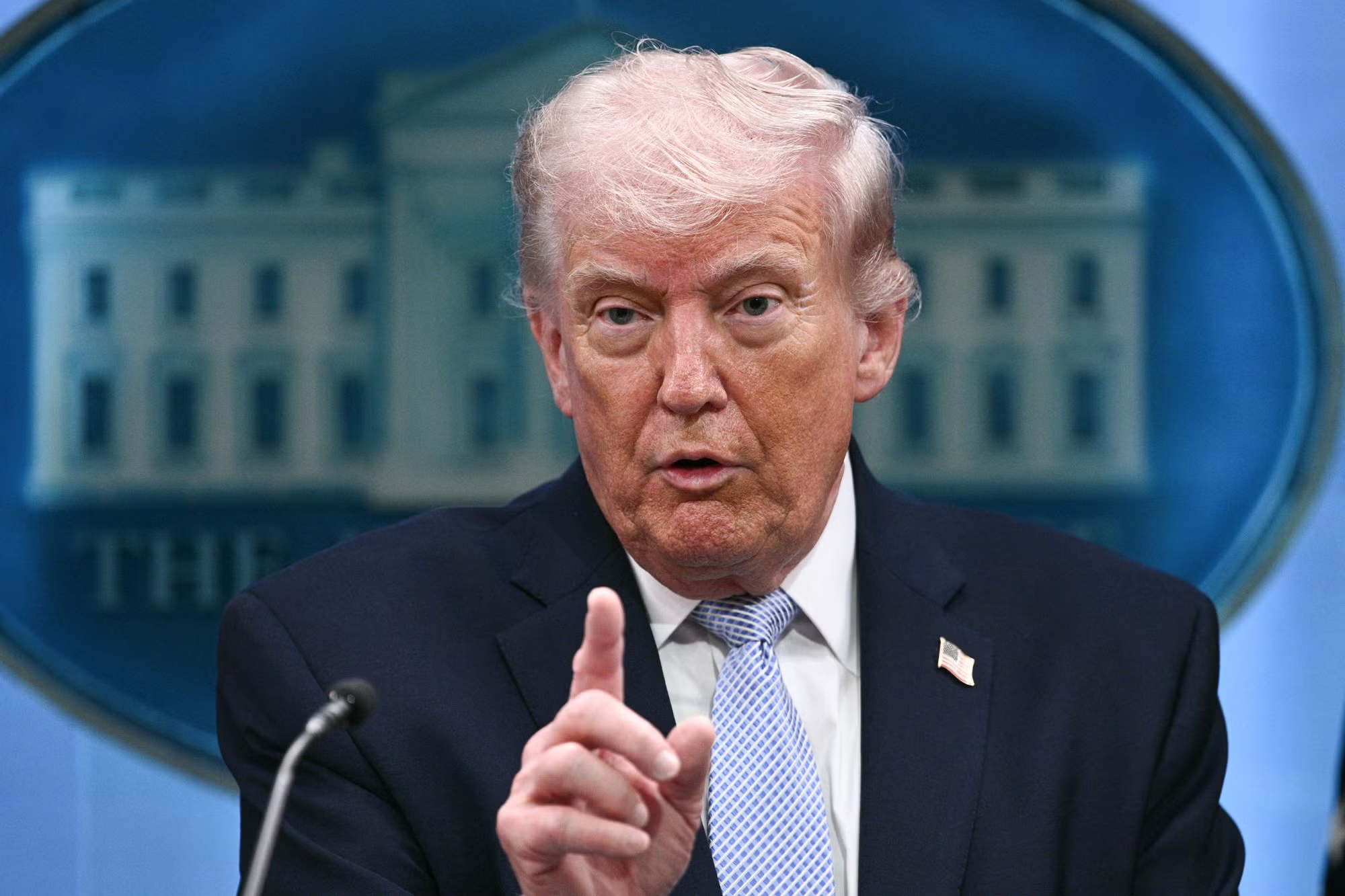
During a highly publicized press conference on Monday, the President did not mince words, stating that the entire country could be effectively neutralized in a single night. He painted a grim picture, explicitly warning that every bridge in Iran would be decimated and every power plant would be destroyed, left burning and entirely beyond repair within a tight four-hour window. This is a severe departure from traditional military warnings, targeting the very foundational systems that keep modern civilization running.
Iran has flatly rejected these demands. In a frightening counter-threat, Iranian officials promised to instantly retaliate against infrastructure belonging to American allies across the Gulf region. The reality is that the desert cities of these allied nations would become virtually uninhabitable within days if their power grids and water desalination plants were knocked offline. The stakes have truly never been higher.
The Rhetoric That Shocked the International Community
What has set this particular crisis apart is the incredibly raw and aggressive communication style driving the conflict. Setting the tone for the week, President Trump issued his ultimatum via a fiery social media post on Sunday. His message directly commanded Iranian leadership to “Open the Fuckin’ Strait” while referring to them as “crazy bastards” who would soon be living in hell.
Iranian officials have publicly characterized this language as the desperate ramblings of a delusional administration. Iran’s envoy to the United Nations formally responded by classifying the threats as a direct incitement to terrorism. They argue that targeting civilian bridges and power grids provides clear evidence of an intent to commit war crimes under established international law.
Israel’s Involvement and the Chilling Warning to Civilians
The situation on the ground is already incredibly volatile, even before the Washington deadline expires. Overnight strikes have continued to rattle Tehran, adding layers of complexity to an already chaotic war zone. In a deeply tragic development, a historic synagogue in Tehran was completely destroyed in what Iranian state media described as targeted Israeli air strikes.
Footage circulating in Iranian media revealed Hebrew-language texts scattered among the rubble of the Rafi-nia synagogue. Homayoun Sameh, a representative for the Jewish community in Iran’s parliament, expressed deep sorrow and outrage. He noted that the attack occurred during Jewish holidays, completely destroying the ancient building and burying holy Torah scrolls under concrete. Iran houses one of the largest Jewish communities in the Middle East outside of Israel, and this incident has sent waves of grief through a population already battered by war.
Adding to the anxiety, Israel’s military bypassed the American timeline entirely and issued its own chilling threats on Tuesday. In a Persian-language social media post, they warned Iranian citizens to stay far away from all railways, explicitly stating that anyone present on trains or near railway lines was actively endangering their own lives.
How Global Markets are Reacting to the Standoff
Back in the United States, the economic anxiety is palpable. Wall Street traders and energy investors are currently frozen in a state of deep uncertainty. The impending Trump deadline for Iran to open the Strait of Hormuz has created a massive guessing game for the global economy. If the deadline passes and infrastructure crumbles, we could see an unprecedented disruption to energy supplies that would immediately hammer the global economy and send domestic gas prices soaring.
Financial analysts are struggling to map out predictions. Kyle Rodda, a senior markets analyst, accurately summarized the mood by stating that the market is trapped on a Trump-imposed countdown clock. Because the President has abruptly called off similar threats in the past, investors are hesitant to bet heavily in either direction. The bravest traders are attempting to hedge their risks, but the vast majority of market participants are simply waiting to see if the rhetoric will materialize into destruction.
The Desperate Push for Diplomatic Mediation
Behind the scenes, there is a frantic scramble to pull both nations back from the brink. Pakistan has stepped in as the primary diplomatic go-between, attempting to broker a miracle in the eleventh hour. Iran’s ambassador to Pakistan confirmed that these backchannel endeavors were approaching a highly sensitive and critical stage.
The proposed Pakistani compromise reportedly involves a temporary ceasefire paired with an immediate lifting of the strait blockade. This would effectively punt the broader peace settlement to future negotiations. However, Iran has reportedly countered with a strict ten-point demand. Their terms require a permanent end to the war, the total lifting of economic sanctions, and a guaranteed commitment from the United States and Israel to fund the reconstruction of all damaged Iranian sites. Furthermore, they are demanding a brand new mechanism to govern passage through the Strait of Hormuz, signaling that they will not easily surrender their geographical leverage.
Voices from the Ground: Are We Looking at a Massive Bluff?
For the millions of everyday civilians caught in the crossfire, the psychological toll is immense. Inside Iran, many residents are desperately holding onto the hope that this is yet another high-stakes bluff designed to force diplomatic concessions.
Ordinary citizens, like thirty-seven-year-old Shima from the central city of Isfahan, are pleading for a peaceful resolution. In conversations with international media, she reflected a sentiment shared by many frustrated Iranians. While she desires a change in her country’s hardline clerical government, she fears that the total destruction of public infrastructure will permanently rob her people of their ability to build a future.
In a display of defiance and solidarity, Iran’s deputy sports minister, Alireza Rahimi, issued a public call for artists and athletes to mobilize. He requested that they form human chains around power plants across the country as the Tuesday deadline approaches. Their goal is to stand hand in hand to send a message to the world that attacking basic public utilities is fundamentally unjust.
What Comes Next for the US and the Middle East
As the final hours slip away, the global community remains paralyzed by the Trump deadline for Iran to open the Strait of Hormuz. We are witnessing a high-stakes game of geopolitical poker where both sides claim to have the upper hand and neither seems willing to blink.
Whether the United States executes a devastating display of military might, or an eleventh-hour diplomatic breakthrough orchestrated by Pakistan saves the day, the fallout of this week will be felt for decades. The reliance of the American economy on stable global waterways has never been more apparent. As we wait for the clock to strike eight in Washington, one thing is certain: the rules of international engagement are being rewritten right before our eyes, and the consequences will be felt by everyone from the citizens of Tehran to the drivers on American highways.