
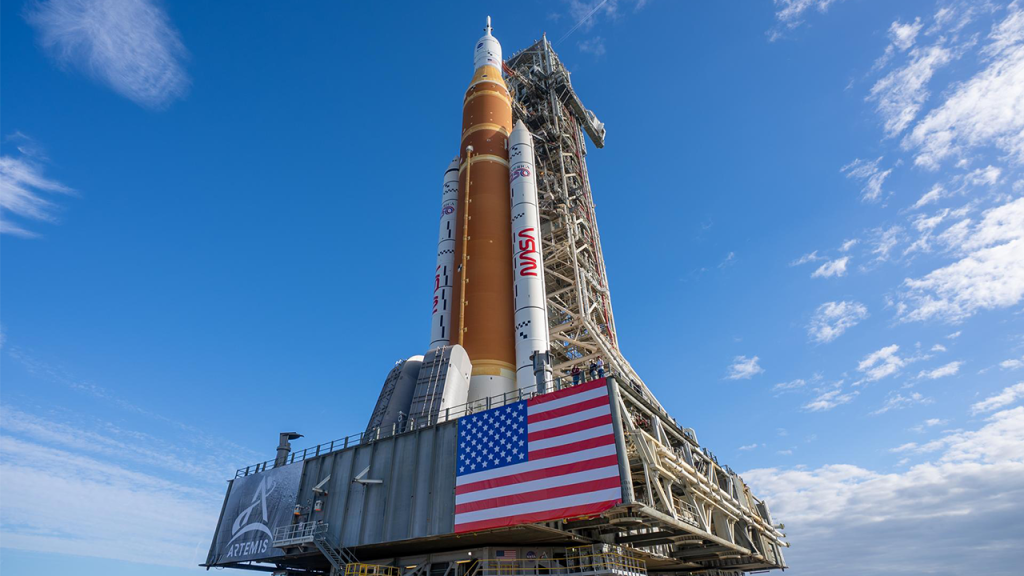
For the first time in over fifty years, humans are about to leave the “comfort zone” of Earth’s low orbit and head back toward the Moon. If you’ve felt a sense of déjà vu watching a massive rocket stand tall on Pad 39B at the Kennedy Space Center, you aren’t alone. But this isn’t a rerun of the 1960s. This is Artemis II, and it represents the most significant leap in human spaceflight since the final Apollo mission in 1972.
As the countdown ticks away in Florida, the excitement isn’t just about the fire and smoke of a launch; it’s about the four individuals strapped into the Orion spacecraft who are about to make history. This 10-day mission is the ultimate “dress rehearsal” for a future lunar landing, and here is everything you need to know about why this moment matters for the future of humanity in space.
The Crew Breaking Barriers: Who is Onboard Artemis II?
One of the most striking differences between the Apollo era and the Artemis program is the faces looking back from the helmets. NASA has been vocal about its goal to make the Moon accessible to everyone, and the crew of Artemis II is the living embodiment of that promise.
A Diverse Team for a New Era
The mission features a crew of four seasoned professionals, each bringing a unique set of skills and milestones to the table:
- Victor Glover (Pilot): Glover will become the first person of color to travel beyond low Earth orbit. A veteran of the International Space Station (ISS), his technical expertise is crucial for testing Orion’s manual handling.
- Christina Koch (Mission Specialist): Koch holds the record for the longest single spaceflight by a woman. On this mission, she will become the first woman to venture into deep space.
- Jeremy Hansen (Mission Specialist): Representing the Canadian Space Agency (CSA), Hansen will be the first non-American to ever leave Earth’s immediate vicinity, marking a new level of international cooperation in lunar exploration.
- Reid Wiseman (Commander): A veteran naval aviator and former Chief of the Astronaut Office, Wiseman leads the mission with a focus on system validation and safety.
This isn’t just about representation; it’s about bringing the best minds from different backgrounds to solve the most complex problems in the universe.
The SLS Rocket: A 322-Foot Tall Marvel of Engineering
To get these four astronauts to the Moon, NASA is utilizing the Space Launch System (SLS). If you haven’t seen it in person, it’s hard to grasp the sheer scale. At 322 feet tall, it’s roughly the height of a 30-story building and produces a staggering 8.8 million pounds of thrust at liftoff.
Why SLS is Different
Unlike the commercial rockets we often see from SpaceX, the SLS is designed specifically for “deep space” missions. It’s a collaboration of industry giants: Boeing handled the core stage, Northrop Grumman provided the solid rocket boosters, and the engines—the RS-25s—are updated versions of the legendary Space Shuttle main engines.
Perched atop this massive pillar of fire is the Orion spacecraft, built by Lockheed Martin. Orion is the life support system that will keep the crew safe during their 10-day journey, protecting them from the harsh radiation of deep space and the blistering 5,000°F heat of re-entry.
The 10-Day Mission Profile: What Happens After Launch?
Artemis II isn’t a direct shot to the Moon. It’s a carefully choreographed dance in two parts.
- Earth Orbit Checkouts: After reaching space, the crew will spend the first 24 hours in a High Earth Orbit. This is a critical safety phase. The astronauts will test Orion’s life support, communication, and navigation systems while they are still close enough to Earth to abort the mission if something goes wrong.
- The Trans-Lunar Injection: Once the “all-clear” is given, the rocket’s upper stage will fire, sending Orion on a trajectory toward the Moon.
- The Lunar Flyby: The crew won’t orbit the Moon like a traditional satellite. Instead, they will perform a “free-return trajectory.” They will swing around the far side of the Moon, using lunar gravity to slingshot them back toward Earth. At their furthest point, they will be thousands of miles beyond the Moon—further than any human has ever traveled.
Insight: Think of Artemis II as the ultimate test drive. You wouldn’t take a brand-new car on a cross-country trip without checking the brakes and the engine first. This mission ensures that when we finally do land on the surface with Artemis IV, the “car” (Orion) is bulletproof.
Comparing Artemis II to Apollo 8: History Rhyming
Space historians often compare Artemis II to Apollo 8, the 1968 mission that first took humans to the Moon. Both missions were bold leaps taken after a series of uncrewed tests. However, the technology gap is astronomical.
While Apollo 8 relied on computer systems less powerful than a modern toaster, Artemis II utilizes advanced AI-assisted navigation, high-bandwidth laser communications, and a spacecraft designed for reuse. Furthermore, while Apollo was a “sprint” to beat the Soviet Union, Artemis is a “marathon” intended to build a permanent presence.
Why the Recent Delay? The Reality of Space Travel
If you followed the news in February, you might remember that the Artemis II “stack” had to be rolled back into the Vehicle Assembly Building (VAB). Space travel remains a high-stakes game where “good enough” isn’t an option.
NASA identified technical issues with the electronics and battery systems within the Orion capsule. Rather than rushing to meet a deadline, the agency chose safety. This level of caution is exactly why NASA maintains its reputation as the gold standard for exploration. As NASA Chief Historian Brian Odom puts it, we are “picking up where we last left off,” but we are doing it with five decades of added wisdom.
The Road to Artemis III, IV, and Beyond
The mission landscape has shifted slightly in recent months. Originally, Artemis III was slated to be the big landing. However, NASA recently “rejiggered” the schedule to ensure the landing vehicles—being developed by SpaceX and Blue Origin—are fully flight-proven.
- Artemis III: Will now focus on testing lunar lander docking and systems in high Earth orbit.
- Artemis IV (2028): This is the current target for the actual boots-on-the-moon moment.
- The Lunar Gateway: Eventually, NASA aims to build a space station in lunar orbit, serving as a “gas station” and laboratory for missions to Mars.
The goal isn’t just to leave footprints and flags this time. It’s about establishing a “lunar real estate” market, finding water ice in the shadowed craters of the South Pole, and using the Moon as a springboard for the first human mission to Mars.
Final Thoughts: Why We Should All Be Watching
In a world that often feels divided, space exploration remains one of the few endeavors that brings humanity together. Artemis II isn’t just a NASA mission; it’s a human mission. When those four astronauts look back at a “blue marble” Earth from the far side of the Moon, they won’t see borders—they’ll see home.
Whether you’re a space geek or just someone who appreciates a good comeback story, Artemis II is the moment the “Moon Age” officially returns. Don’t miss the launch—history is being written in the stars.